– Rolling Program Entry (хэрэв оюутнуудын саналыг хүлээн авбал жилийн аль ч үед элсэх боломжтой)
- Israel Scholarship Program
– Запись по непрерывной программе (студенты могут поступить в любое время года, если их предложение принято)
– Rolling Program Entry (students can enter at any time of the year if their proposal is accepted)
Doctoral Studies – global level research and training with international professors and supervisors as excellent, content and development options for you
- in-person, online thesis direction with international professors and supervisors
- fascinating research opportunities in many unexplored academic, mental and geographical regions as research choices, ventures and explorations of your kind
Thesis Options Дипломын ажлын сонголтууд
Thesis research areas open for proposals. Thesis research options offered at doctoral and masters research levels. Subject to approval by Director of Institute.
Process of Study
- Contact Director of Studies with your thesis proposal
- Email your 12-page proposal including a 2-page seminal authorship bibliography (PDF format) to the Director of Studies at: ccoles@protonmail.com
Possible Thesis Research Topics:
‘The Enigma of Jewish Presence in Mongolian Lands’ (Doctoral Submissions Open)
‘Israeli Epigenetics and Cardiology in Mongolian Healthcare’ (Doctoral Submissions Open)
‘Harsh Climate Food Production Potentials in Mongolia’ (Doctoral Submissions Open)
‘Jewish Presence in the Court of Chenggis Khan’
‘Israeli Robotics Usage in Mongolia’
‘Israeli Agrotechnology Integration in Mongolia’
‘Israeli Supply Chain Management in Mongolia’
‘Israeli Hydrology Technology Usage in Mongolian Agricultural Sector’
‘Medieval Jewish Influences on Mongolian Linguistics and Society’
‘Israeli Medicine Application in Mongolian Hospitals’
‘Mongolian and Jewish DNA Samples in Central Asia’
‘Jews and Nestorian Christians: Merchant-Priests of the Silk Roads’
others ..
- contact director of studies as other proposals may be possible and or accepted for your study at the Finkelperel Institute of Israeli and Jewish Studies

Admixture and its relationship with LD. (A–C) Ancestral population clustering and PCA were performed using the combined AJ and HGDP populations. The AJ population was divided into three random subgroups of 157 individuals to better match the population size of the Middle Eastern and European populations in the HGDP dataset. The data shown represent one subgroup, and all three had similar results. (A) Population clustering analysis of AJ and all HGDP individuals for seven, K = 7, theoretical ancestral populations. Each color represents a different ancestral population and each vertical line represents a single individual. The proportion of each color within an individual signifies the fraction of ancestry derived from the color’s ancestral population. The red arrow highlights the AJ population. (B) PCA performed using only the AJ, Middle Eastern, and European HGDP populations. (C) Population clustering analysis with K = 3 (Upper) or K = 2 (Lower) ancestral populations, performed using only the AJ, Middle Eastern, and European HGDP populations. (D) The correlation between admixture and LD was determined by plotting the average r2 for all SNP pairs within the given intervals of δ1δ2, where δ1 is the allele frequency difference between the founding populations at locus 1, and δ2 is the frequency difference at locus 2. The legend indicates the populations representing the founding populations: Middle Eastern (ME), European American (EA), or Yoruba in Ibadan, Nigeria (YRI). Error bars show SEM.
Source:
Signatures of founder effects, admixture, and selection in the Ashkenazi Jewish population
Steven M. Bray, Jennifer G. Mulle, Anne F. Dodd, +2, and Stephen T. Warren swarren@emory.eduAuthors Info & Affiliations
Edited by Arno G. Motulsky, University of Washington, Seattle, WA, and approved July 16, 2010 (received for review March 31, 2010)
August 26, 2010
107 (37) 16222-16227
https://doi.org/10.1073/pnas.1004381107
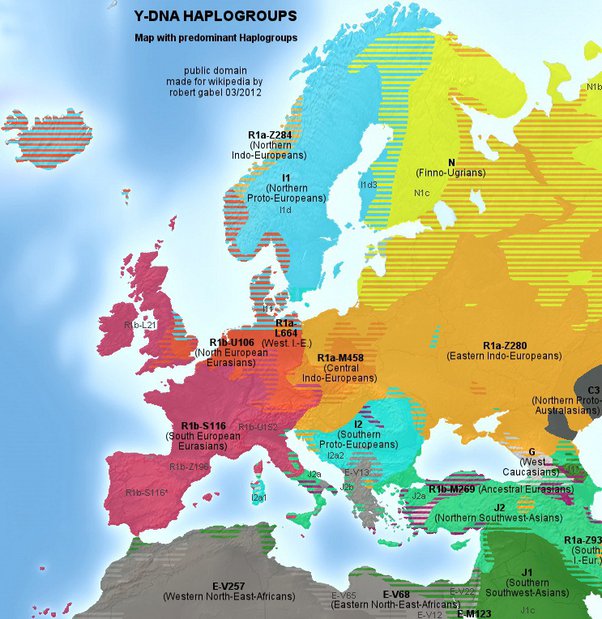
Y-DNA Haplogroup Europe and MENA
 Finkelperel Institute for Israeli and Jewish Studies