
Judaica Mongolica
- Judaica Mongolica – journal for Jewish Studies in Mongolia, Buryatiya, Inner Mongolia, Central Asia, Far East and the larger Mongolian Diaspora
- Join our Finkelperel Institute Graduate School Research Team to explore more fascinating Jewish life in Central Asia and the Far East
Features |
Current | The Jewish Pogrom of Lost Urga | July 2025
Mongolia Photographs https://www.europeana.eu/en/search?page=1&vuew=grid&query=mongolia%20photograph
Issue 1 | Report on the Russian Caravan Trade with China. Harry Parkes. The Journal of the Royal Geographical Society of London, Vol. 24 (1854), pp. 306-312 (7 pages)https://doi.org/10.2307/3698123 https://www.jstor.org/stable/3698123
Issue 2 | Irina M. Zakharova, Maria V. Mandrik. On the Preparation of a Private Commercial, Industrial and Scientific Expedition of the Butin Brothers to China in 1870 — 11 (p11)
– The paper continues authors’ research of the commercial, industrial and scientific expedition of the Butin brothers to China previously discussed in Zakharova and Mandrik in 2020, and reveals the history of the expedition arrangement, the stages of its progress through state institutions. Thanks to their management skills, the merchants Butins were able to enlist the support of the local authorities of Eastern Siberia, the large merchants of Siberia and St. Petersburg, the governments of Russia and China. Their persistence in trying to organize the expedition was the key to its success and expanded the possibilities of Russian trade in Asia.
Keywords: brothers N. D. and M. D. Butins, expedition to China, Russian-Chinese trade, M. S. Korsakov, Kyakhta merchant I. A. Noskov.
Issue 3 | Russian Scientific-Commercial Expedition to China, 1874-75 (photographs)
Issue 4 | The Development and Change of Kyakhta Trade in the 18th and 19th Centuries Following the regulation of Qing-Russian trade by the Treaty of Kyakhta of 1727, a caravan route was opened between Beijing and Kyakhta, along which Urga (Ulaanbaatar) was eventually settled
Issue 5 | Jews in Inner Mongolia article
Issue 6 | Jewish Merchants Frazier and Novokovskii
Issue 7 | Lev Izmailov mission in 1719/22 to Peking
Issue 8 | M. Shiotani, Tohoku University, Sendai, Japan The Export of Russian Cotton Fabrics
and the Commercial Network of Asian Merchants
in the First Half of the 19th Century. Part 2 (p.47)
Issue 9 | JEWISH TRAGEDY IN INNER MONGOLIA
By Mikhail Rinsky The Russian government encouraged the resettlement of Jews from overpopulated towns, hoping the resourceful settlers would engage in trade and supply cities and stations along the railway.
Issue 10 | The Historic Architectural Legacy
of the Chita Region in Eastern Siberia
Issue 11 | The Russians on the Amur its discovery, conquest, and colonisation, with a description of the country, its inhabitants, productions, and commercial capabilities and personal accounts of Russian travellers
Issue 12 | Jews and Cossacks in the Jewish Autonomous Region Felix Ryansky
Issue 13 | History of Russian Embassies to China
Issue 14 | The Mysterious Case of a Mongolian Murder That Might Have Been…
Issue 15 | Sketch of a Journey from Gehol in Tartary by land to Peking
Issue 16 | Imperial rivals China, Russia, and their disputed frontier by S. C. M. Paine
Issue 17 | Maier, Lother (1981). “Gerhard Friedrich Müller’s Memoranda on Russian Relations with China and the Reconquest of the Amur”. The Slavonic and Eastern European Review. 59 (2): 219–240.
Issue 18 | The Ili Region under Russian Rule (1871-1881) J. Noda
Issue 19 | Sergey Ivanovich Borisov (1859-1935) Photo Collection (1907-11) who traveled across the Altai Mountains, taking over 1500 photos of the indigenous Altai people, Kazakhs and Russian settlers. His postcards reveal the Altay, or Altai, Mountains region of southern Siberia (early 20th century)
Issue 20 | The ‘Mongolian Mission’ of the London Missionary Society: An Episode in the History of Religion in the Russian Empire. The Slavonic and East European Review (1978). https://www.jstor.org/stable/4207672
Issue 22 | Stallybrass-Swan Mission to the Buryats https://homerton250.org/people/edward-stallybrass/
Issue 23 | Smirnova I.Y. The British Missionary Project in Transbaikalia (1817–1840) Useful 19th Transbaikal regional social data. London Missionary Society British Imperial Policy, Imperial Russia Qing Empire Trade, very useful bibliography
Issue 24 | The Jews of Manzhouli (Russian: Манжули (Manzhuli) Chinese: Lubin [臚濱; Lúbīn; Lu2-pin1 , ) Manchuria
Issue 25 | Making Baikal Russian: Imperial Politics at the Russian–Qing Border discusses power asymmetries and transcultural entanglements in the Baikal region on the border between the Russian and Qing empires
Issue 26 | The Eye of the Tsar: Intelligence-Gathering and Geopolitics in Eighteenth-Century Eurasia understanding the relationship between the Russian Empire, the Qing Dynasty, and European actors, from the mid-seventeenth to the early nineteenth century. Focuses on intelligence-gathering, including espionage, as a genre of intellectual work situated in state institutions, oriented toward pragmatic goals, and produced by and for an audience of largely anonymous bureaucrats. Uses archival sources from Moscow, St. Petersburg, Paris, London, and Rome, as well as published materials. Investigating how seventeenth-century Siberians compiled information about China, and how maps and documents were transmitted first to Moscow and then to Western Europe to be republished for wider audiences. It then examines the post-Petrine shift to more specialized forms of intelligence-gathering, focusing on industrial espionage in the Moscow-Beijing trade caravan. Changing priorities of the Russian intelligence gathering apparatus shaped and often crippled the ability of Russian Qing experts to address wider audiences. On the mid-eighteenth-century Russo-Qing border, the dissertation follows the building of a robust Russian intelligence network in Qing Mongolia amid unprecedented inter-imperial tension, and its ultimate failure to achieve desired geopolitical ends. These intelligence failures are then shown to provide a compelling new explanation for the collapse of European imperial attempts at diplomacy in East Asia in the last third of the eighteenth century. Finally, the dissertation concludes by showing how, by means of strategic forgetting, intelligence was reconstructed into academic sinology during the reign of Alexander I.
Issue 27 | JEWISH TRAGEDY IN INNER MONGOLIA
By Mikhail Rinsky – testimonials of Jewish emigrees in Manchuria and Inner Mongolia. Geographical note: Manzhouli (Mongolian: Манжуур is a sub-prefectural city located in Hulunbuir prefecture-level city, Inner Mongolia Autonomous Region, China.
Issue 28 | Invisible Sovereigns. Dialogues in the Russian–Buryat Colonial Encounter In Italo Calvino’s influential book Invisible Cities (1974) Kublai Khan interrogates Marco Polo about the cities he has seen on his journeys. The ageing emperor senses that a moment has come when his pride in the boundless expansion of his conquered territories faces the melancholy awareness of not knowing or understanding them. Marco Polo describes the cities he has seen, each fantastical, strange, and troubling in its own way, cities of memory, hidden cities, trading cities. The text is constructed as a dialogue, in which Kublai Khan mistrusts the traveller’s answers while constantly asking for yet more reports, and Marco Polo seems to probe the emperor: what holds your empire together? what is the light it brings?
Another genre consists of folk stories, vernacular histories and songs handed down in more-or-less set forms in the community. Such folk material found in the recently published collections is a continuation in contemporary rendering of the vast assemblage of Buryat-Mongolian lore of the past, some of which was recorded and published by Potanin (1883) and Pozdneev (1880). There are several sub-varieties, üliger (exemplary story), domog (explanatory story), shog (mocking story) and tuuj (epic story). A third register, that I call ceremonial, consists of speech and texts used on ritualised and religious occasions that are framed as separate from everyday life.
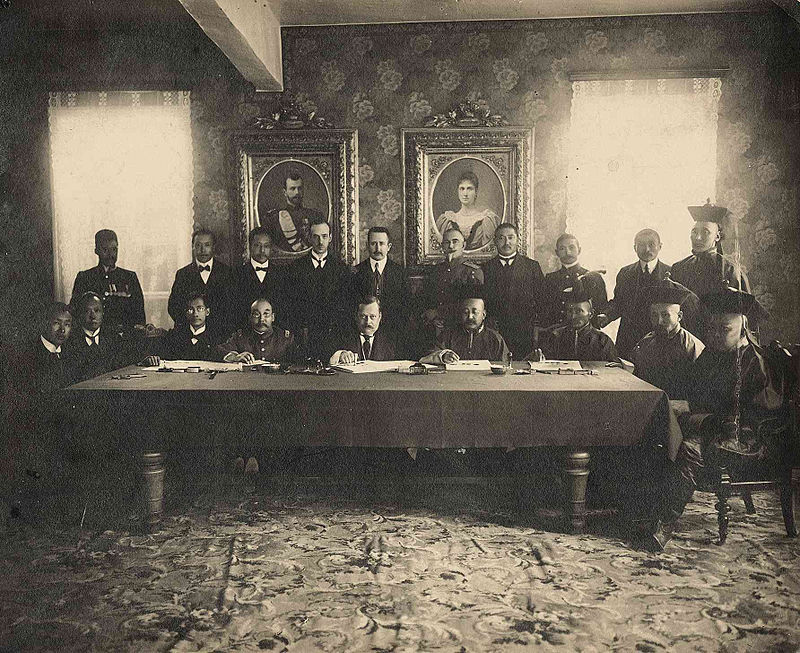
Deputies from China, Russia and Outer Mongolia signing Kyakhta Treaty (1915) From left: Chen Lu (China), Bi Guifang (China), Alexander Miller (Russia), Silningdamding ? (Outer Mongolia), Jacdurjav ? (Outer Mongolia)
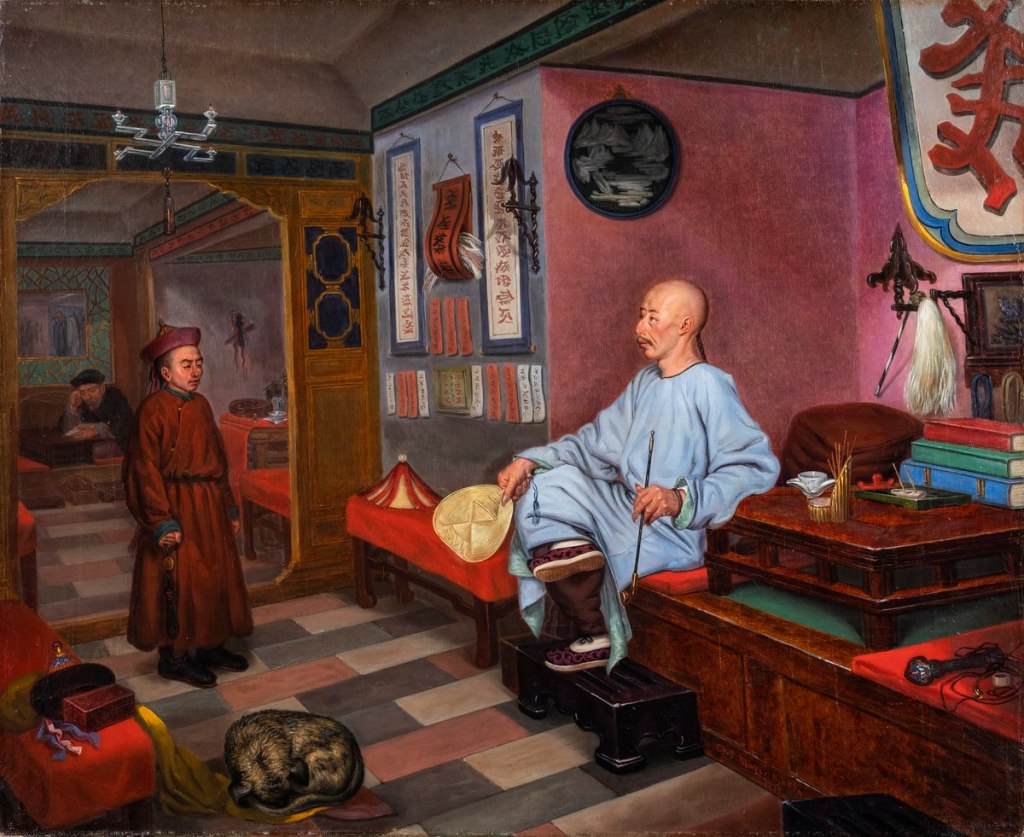
Imperial Russia-Qing Dynasty China Kyakhta Trade and Qing Government Official receiving messenger in office 19th C (reproduction)
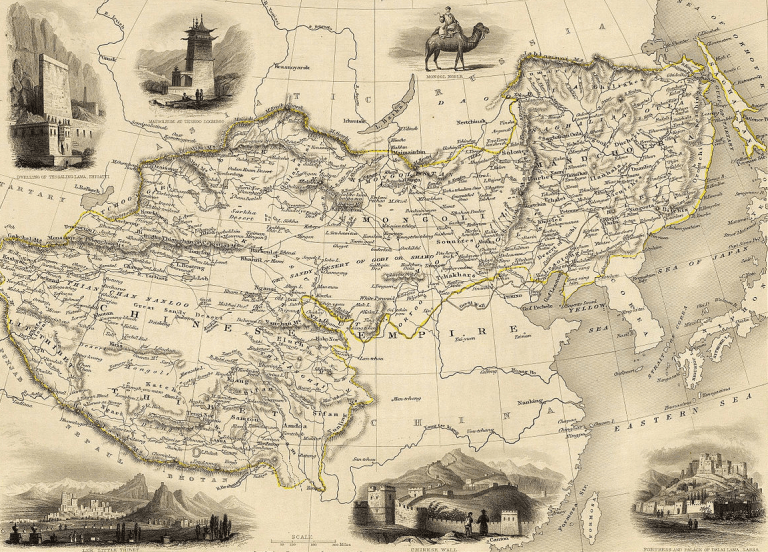
Qing Dynasty China, Inner and Outer Mongolia and the Imperial Russian Far East (map)

Old Tatar Wall, Peking, Mid-19th Century
Disclaimer | full credit to all authors on their research work (above)
 Finkelperel Institute